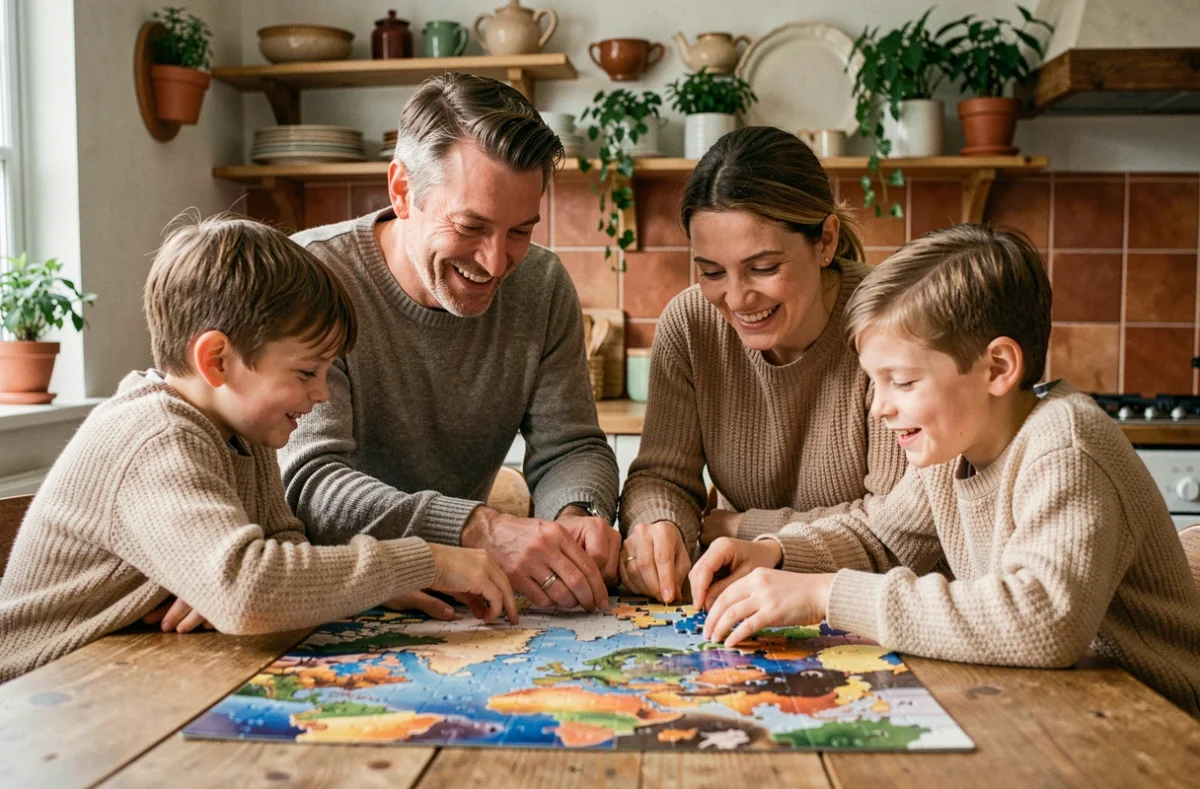
Rainy Wednesdays and evenings without plans quickly turn into everyone-on-their-screen time. The Enabee study, published by Public Health France in September 2025, measures an average of nearly two hours of screen time per day among 6-8 year olds, a figure that nearly doubles on school-free days. Offering a concrete activity, even a short one, changes the dynamic of an entire afternoon. Here are ten testable ideas for this weekend, without expensive materials or complex organization.
1. Treasure Hunt at Home with Riddle Clues
Hide five to eight small objects or envelopes in different rooms. Each clue leads to the next through an age-appropriate riddle for the youngest player. The final treasure can be a dessert, a voucher to choose the evening movie, or a small toy.
What makes this activity effective is the gradual increase in difficulty. Start with a simple rebus, then slip in a math problem, then a message written backward. Four-year-olds follow the group, while ten-year-olds decipher. Parents play the role of referees or participants, depending on the mood.
If you’re looking for ready-to-use scenarios to vary the themes (police investigation, pirate adventure, space mission), platforms like letsplayfamily.fr offer downloadable kits with clues, decor, and rules included.
2. Family Quiz Night with Thematic Rounds
Prepare three rounds of ten questions each: general knowledge, music (guess a hummed tune), and a “family” round where each question is about a household member. Who knows Dad’s favorite color? What is the big sister’s least favorite dish?
The “family” round creates the best memories, as it reveals details that no one had taken the time to share. Keep score on a sheet, and award a champion title for the week. Twenty minutes is enough for a game, making it an easy ritual to fit in after dinner.
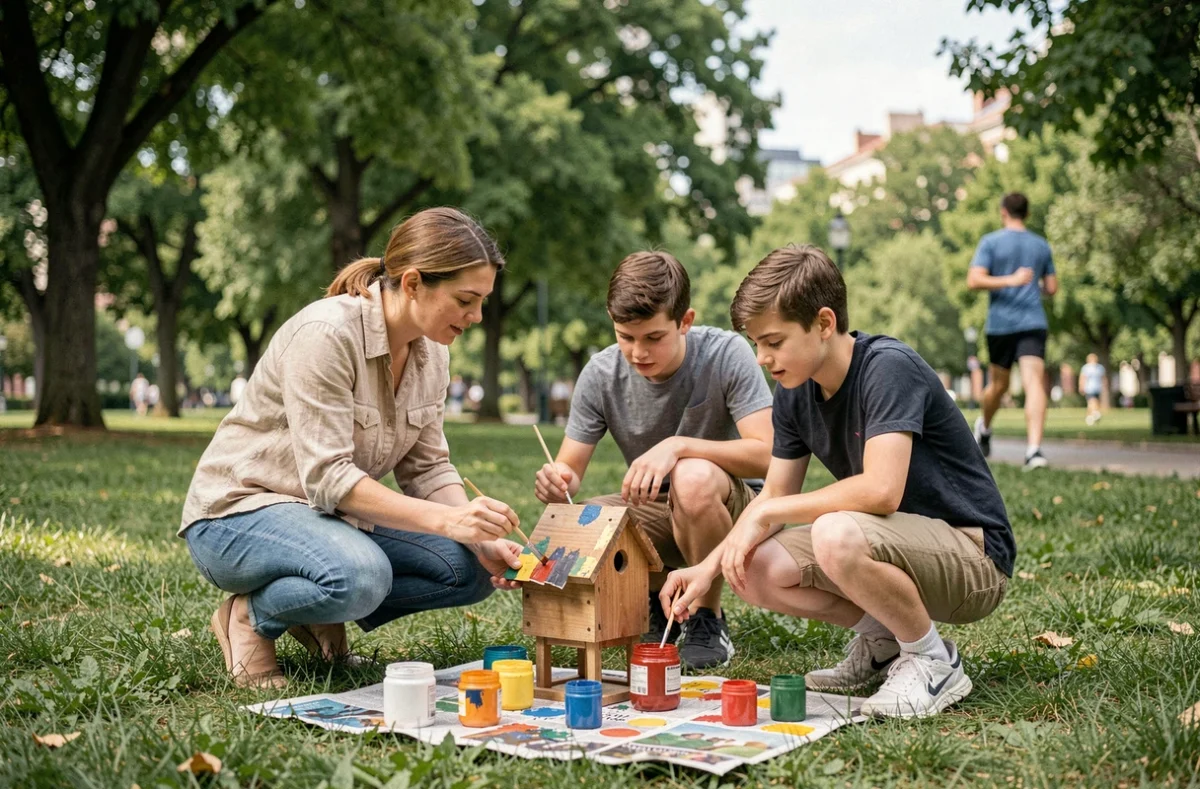
3. Geocaching on a Walk: The Hike with a Purpose
Geocaching transforms an ordinary walk into an expedition. A free app on your phone indicates hidden caches nearby. You follow the GPS, search for a box, sign the logbook, and exchange a small item.
Have you ever noticed that children walk twice as long when they have a goal? Geocaching exploits this very principle. Each found cache triggers a real sense of pride, even among teenagers who claim to be bored. There are thousands of caches in France, including in city centers.
4. Cooking Workshop with a Themed Menu
Choose a country and prepare a complete meal together: appetizer, main course, dessert. Mexico works well (tacos, guacamole, churros), as does Japan (makis, miso soup, mochis).
Divide tasks according to abilities. The younger ones wash the vegetables and mix. The older ones chop and monitor the cooking. Cooking together teaches cooperation without needing to explain it: if no one makes the sauce, the dish has no flavor.
5. Home Escape Game with a Timed Scenario
Gather a combination lock, a few envelopes, and a timer for forty-five minutes. Create a simple story: a stolen treasure, a secret message, a door to open before the countdown ends. Three to five puzzles are enough.
The timer changes everything. It transforms a quiet game into a collective challenge where everyone contributes. Parents participating (rather than organizing behind the scenes) strengthen the bond. The atmosphere resembles professional escape games, without the entry fee.
6. Day of Photo Albums and Childhood Stories
Pull out old photos, printed or digital. Each parent shares a memory related to an image: a mischief, a trip, a funny moment. Then show the children their own baby photos.
This activity requires no materials, just time and availability. Children love discovering that their parents were once little. It opens conversations about extended family, grandparents, and places they have lived.
7. Big Game of Charades and Improvisation Challenges
Write down names of animals, professions, and everyday scenes on folded papers. Each player draws and mimes while others guess. Vary with sound rounds (imitating a sound without speaking) or human sculpture (two players create a frozen scene).
This format suits all ages. A three-year-old mimes a cat, a teenager mimes a math teacher. Laughter comes quickly, especially when an adult gets serious about it.
8. Collective Construction with Recycled Materials
Save boxes, rolls, caps, and string for a week. On Saturday, launch a challenge: build the longest bridge, the tallest tower, or a vehicle that really moves. Set a time limit of one hour.
This type of project develops group problem-solving skills. Here’s what works to structure the activity:
- Define a measurable goal (height, length, ability to support weight)
- Form mixed teams of children and adults to balance skills
- Plan five minutes for presentations where each team explains their choices
9. Family Show with Assigned Roles
Choose a short tale or invent a story. Assign roles, improvise costumes with what you find in the closets, and perform the scene in front of a phone camera or simply in front of the couch turned into a stage.
The goal is not the quality of the show, but the process. Rehearsing a scene together creates a bond different from board games: you negotiate, laugh at the mishaps, and start over. The video becomes a memory to revisit years later.
10. Camping in the Garden or Living Room
Set up a tent in the garden or build a blanket fort in the living room. Bring a flashlight, stories to tell, and a picnic on the floor. The adventure doesn’t depend on the location, but on the atmosphere you create.
This change of scenery is enough to transform an ordinary evening into an event. Children talk more in the darkness of a tent than in front of the television. A few elements make the camping memorable:
- An opening ritual (each member shares the best moment of their day)
- A collaboratively invented story, where each person adds a sentence in turn
- A special breakfast the next morning to extend the experience
None of these activities require a special budget or an entire day. Thirty minutes of shared attention is worth more than three hours of parallel occupation. The High Council of Public Health also recommends prioritizing co-use (an actively participating adult) rather than just a screen time limit. Choose one idea, test it this weekend, and save the others for later.