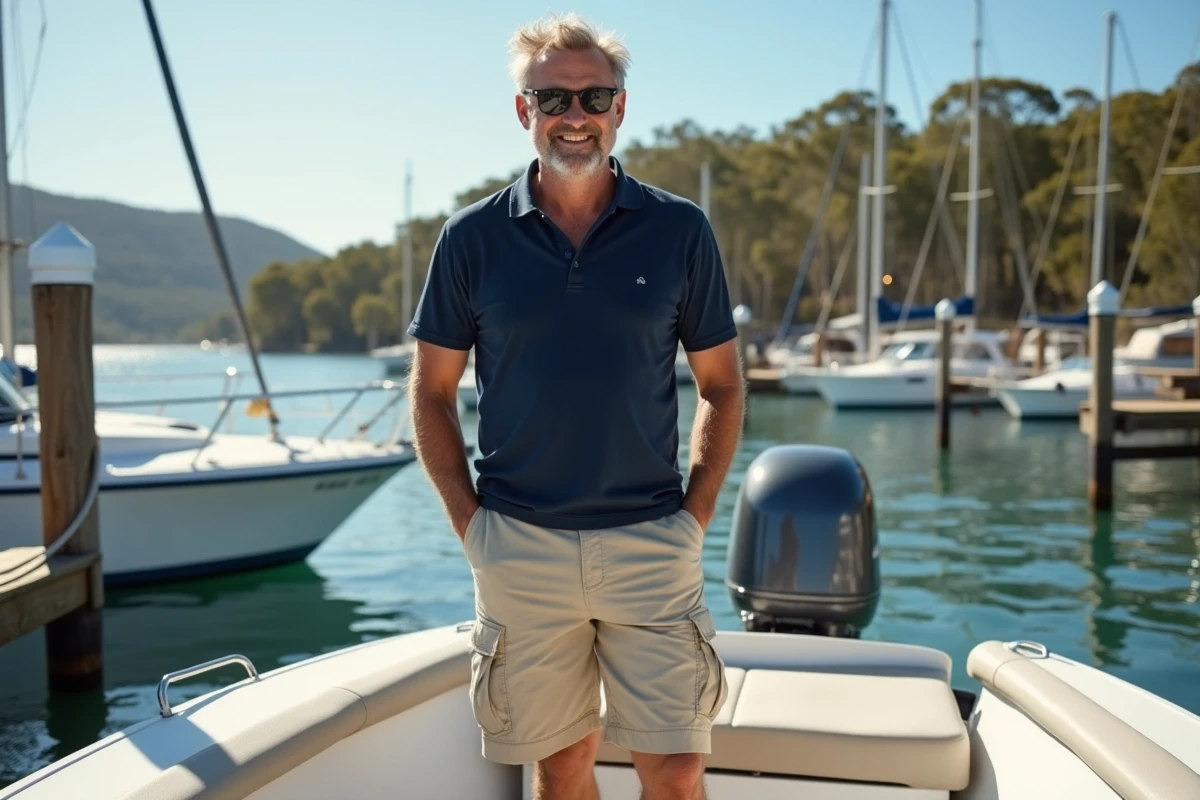
A French boating license does not automatically open all doors in Australia. Here, each state has its own regulatory framework, and a license obtained in Marseille or Dunkirk does not always suffice to convince the authorities in Sydney or Brisbane. Navigating these distant waters means accepting to deal with local requirements that are often unknown to French boaters.
French boating license in Australia: what recognition and what limits?
Arriving in Australia with a French boating license does not exempt one from formalities. On this island-continent, there is no uniform national rule: Queensland, New South Wales, Victoria, Tasmania… each sets its own conditions. Sometimes, a foreign license allows for temporary navigation, often under strict conditions; elsewhere, it requires conversion or even retaking a local exam.
The French distinction between coastal license (up to 6 miles from shelter) and offshore license (open sea navigation) does not really have a direct equivalent on the other side of the globe. Acceptance criteria differ, as do the procedures. Presenting your boating license to go to Australia requires providing translated documents, sometimes an International Certificate (ICC/CPI), and above all, being ready to defend your case before meticulous administrations.
Recognition therefore varies by territory. Here’s a summary of how the main states handle foreign licenses:
- Queensland: systematic request for conversion of the French license, often coupled with a theoretical or practical exam.
- New South Wales: short-term use tolerated if the application includes a certified translation.
- Tasmania and Victoria: each case is studied, prior submission of an equivalence request and formal response required before any navigation.
No state allows for approximation. Inspections are frequent, regulations complex, and every mistake hinders the project. Before casting off, it is therefore better to gather all the required documents imposed by the targeted territory, carefully prepare each step, and expect to meet several distinct requirements.
What documents and procedures to prepare for navigating Australian waters?
For those aiming to navigate in Australia, the administrative burden weighs heavily. The precious key is the International Certificate of Competence (ICC/CPI) obtained in France: without it, access to Australian waters becomes complicated and may result in outright refusal. Authorities systematically expect this document, concrete proof of recognized skills, to validate a request from abroad.
Another essential: the NAATI certified translation. It is impossible to present documents in French; each document, license, or certificate must be translated by a locally accredited professional. This formality acts as a filter: nothing passes without this certification.
Specifically, the boater must gather the following documents:
- The valid International Certificate of Competence (ICC/CPI)
- The NAATI translation for each nautical document required
- A dossier of experience or nautical CV to support a request or rental
- An insurance certificate tailored to Australian specifics and risks
The services of the French embassy or consulate in Sydney are often essential to verify updated requirements and obtain assistance in compiling the dossier. Regarding insurance, be careful not to rely on a simple European contract: coverage outside the European Union is rare, and specific extension must be obtained before setting sail.
Taking care of every administrative detail, anticipating translations, and ensuring overall compliance of the dossier: this is the only way to make an Australian boating project realistic. Stringency is part of the process, and the slightest oversight can delay or even block the authorization to navigate.
Local rules to know before setting sail in Australia
Recreational boating in Australian territory is primarily a regulatory mosaic. Each state or territory imposes its own rules, validates (or not) foreign licenses, and dictates controls on the water. A French license and an ICC often do not suffice to navigate everywhere: the procedure may be burdened by additional verification, training, or even a local safety test.
Conditions also vary when renting. On a small vessel, some bodies of water may sometimes tolerate navigators without a license, but this relative freedom vanishes as soon as one moves up in power or ventures offshore. Rental companies generally require a recognized license accompanied by a detailed nautical CV. In case of doubt, or in the absence of official recognition, there remains the option to rent with a professional skipper accredited on-site, the only solution to explore without regulatory hassles and ensure safety.
Nothing is left to chance: legislation covers the mandatory wearing of life jackets, onboard equipment, compliance with restricted zones, and maritime signaling specific to each state. Preparation therefore requires reading the local regulations in detail and assuming nothing is guaranteed, lest one’s project be abruptly halted by an uncompromising administration.
In summary, coming to navigate in Australia with a French license means accepting to enter an administrative maze where vigilance, foresight, and adaptability make all the difference. Before daring to venture out, everyone must ask themselves if they are ready to make paperwork their first stop… or if they prefer to postpone their maritime dreams to a more lenient sea.