A goal net installed in the garden often ends up in tatters after a few months. The problem does not come from the shots, but from the choice of rope and assembly technique. Making a football goal net that withstands UV rays, rain, and repeated strikes requires some decisions made in advance, even before taking out the spool.
UV-stabilized synthetic rope: the detail that changes the lifespan of the net
There are many tutorials recommending garden twine or braided cotton rope. On an outdoor goal net, these materials degrade within a few weeks due to the combined effects of sun and moisture.
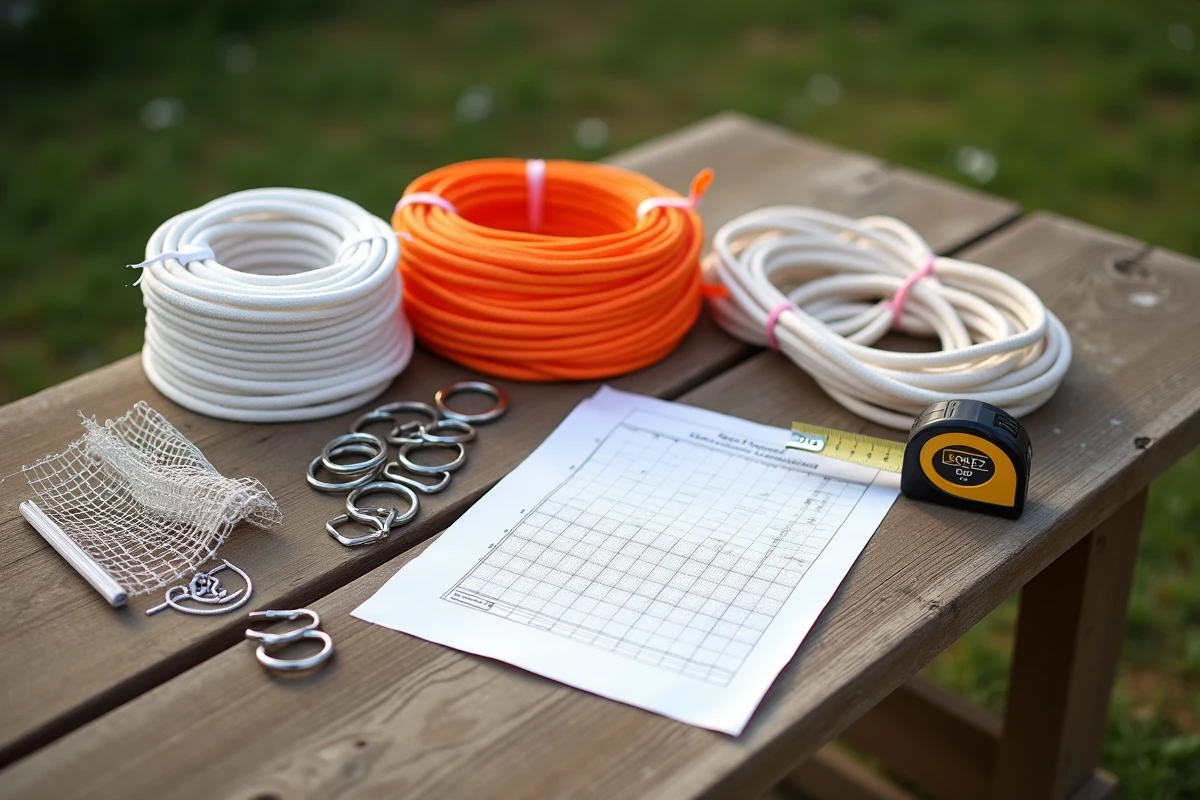
The most accessible solution today involves UV-stabilized polypropylene cords. These can be found in general hardware stores, particularly at Leroy Merlin, which offers spools labeled “extended outdoor use, UV stabilization.” High-density polyethylene (HDPE) is another solid option, a bit stiffer to the touch but very resistant to abrasion.
To choose well, we prefer a diameter between 3 and 4 mm. Below this, the rope marks the hands when tying and breaks faster under tension. Above this, the net becomes heavy and loses its flexibility, complicating folding if you want to store the goal after use.
Before starting to make a football goal net, we calculate the necessary footage. For a standard garden goal, we count about three to four times the perimeter of the frame in rope, depending on the desired mesh size. It’s better to buy a spool with a comfortable margin than to have to join two lengths in the middle of the net.
Mesh size and EN 748 standard: what safety requires from the DIYer
The size of the mesh is not chosen at random. European standards EN 748 (football goals) and EN 913 (training equipment) regulate this point for safety reasons, particularly for children.
Too wide mesh allows the ball to pass through or lets a child slip their head through. Too tight mesh makes the net heavier and complicates assembly. We aim for a compromise around 10 to 12 cm per side for a garden goal intended for children, and up to 15 cm for adult use.
The tension of the net also plays a direct role in safety. A net that is too loose forms pockets where the ball accumulates and pulls on the fixings. A net that is too tight transmits shocks to the frame and eventually tears the attachment points. We seek a medium tension, with a slight flexibility in the center of the net to absorb the impact of shots.
Tying technique for regular mesh
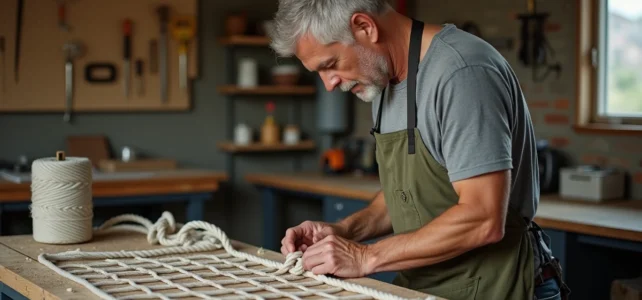
The net knot (or weaver’s knot) remains the reference. We work with a flat shuttle, a low-cost tool that allows for maintaining a constant length of thread between each knot. Here’s the method summarized:
- Fix a horizontal starting bar (a broom handle or a PVC tube wedged between two supports) and attach the vertical strands at regular intervals, corresponding to the chosen mesh width.
- Work row by row, tying each strand to the neighboring strand with a weaver’s knot, using the shuttle as a template to ensure the mesh height.
- Check the regularity every three or four rows by measuring the diagonal of the meshes, and correct immediately if a knot slips.
Feedback varies on this point, but a more regular net is generally achieved by working in dry weather, as wet synthetic rope tends to slip in knots.
Repurposing an agricultural net to save time
For a few years now, a trend has emerged among DIYers: repurposing bird nets or aviary nets to adapt them to a goal frame. Distributors like Filets de France or Puteaux SA offer square mesh sheets, already woven, sold by the meter.
The advantage is obvious. It eliminates the entire tying phase, which easily represents several hours of work. You cut the sheet to the dimensions of the frame, fix it with zip ties or stainless steel rings, and the assembly is completed in less than an hour.
However, the agricultural net has some limitations. The mesh is often finer (around 20 to 25 mm), which gives a very different visual result from a classic goal net. The ball also bounces differently, with a “tarpaulin” effect that can be bothersome in use.
For a training or leisure goal in the garden, an aviary net made of HDPE works perfectly. For more intensive use, hand-tying with 3 to 4 mm rope remains superior.
Securing the net to the frame: ties, hooks, or bungee cords
A well-tied net is useless if it is poorly secured to the goal frame. There are three methods depending on the frame material.
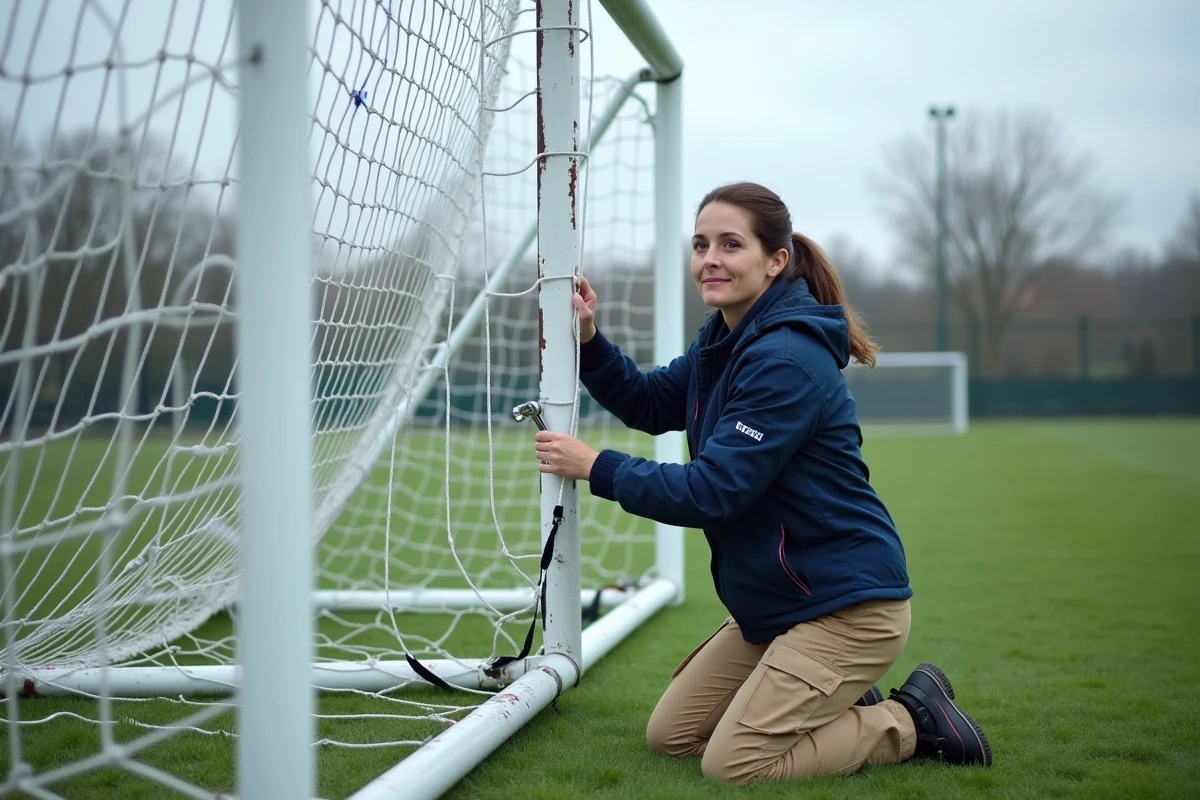
- PVC or plastic tube frame: nylon zip ties (Rilsan type) are the quickest solution. One is placed every 15 to 20 cm along the uprights and the crossbar. They are easily cut for replacement.
- Wood frame: screw hooks (open eyes) allow the net rope to pass without cutting it. This way, you can still retighten the net by sliding it.
- Metal frame: short bungee cords (hooked elastics) absorb vibrations and protect both the net and the frame. They are spaced about 20 cm apart.
Whatever the system, check the fixings every few weeks during the usage season. A single broken attachment point creates a domino effect that stresses nearby fixings and can tear the net.
Maintenance to extend lifespan
Removing the net when the goal is not used for several weeks remains the best protection against UV rays and stagnant moisture. It should be stored dry, rolled without compressing. A quick rinse with a water jet once a month is enough to remove dirt and plant residues that accelerate the degradation of synthetic fibers.
A net made of UV-stabilized polypropylene rope, properly tied and regularly maintained, lasts several seasons without replacement. The time spent choosing the right material at the start avoids having to redo the work every spring.